
M-Line Blog
Protective Packaging: How to Select the Right Materials for Damage Prevention
Every year, manufacturers lose thousands of dollars due to shipping damage such as crushed components, cracked housings, and scuffed surfaces that never should have made it out the door. In most cases, the problem isn't the carrier. It's packaging method.
Selecting the right protective packaging materials requires more than picking a box and adding bubble wrap. It means understanding your product's weight, fragility, and surface sensitivity, the shipping environment it will move through, and the total cost impact of every material decision. At M-Line, we engineer custom protective packaging solutions that help manufacturers reduce damage, control costs, and improve supply chain performance for precision components, electronic assemblies, automotive parts, and industrial equipment.
Understanding the Main Types of Protective Packaging
Protective packaging generally falls into three categories, each with distinct advantages depending on the application:
Foam Packaging and Inserts
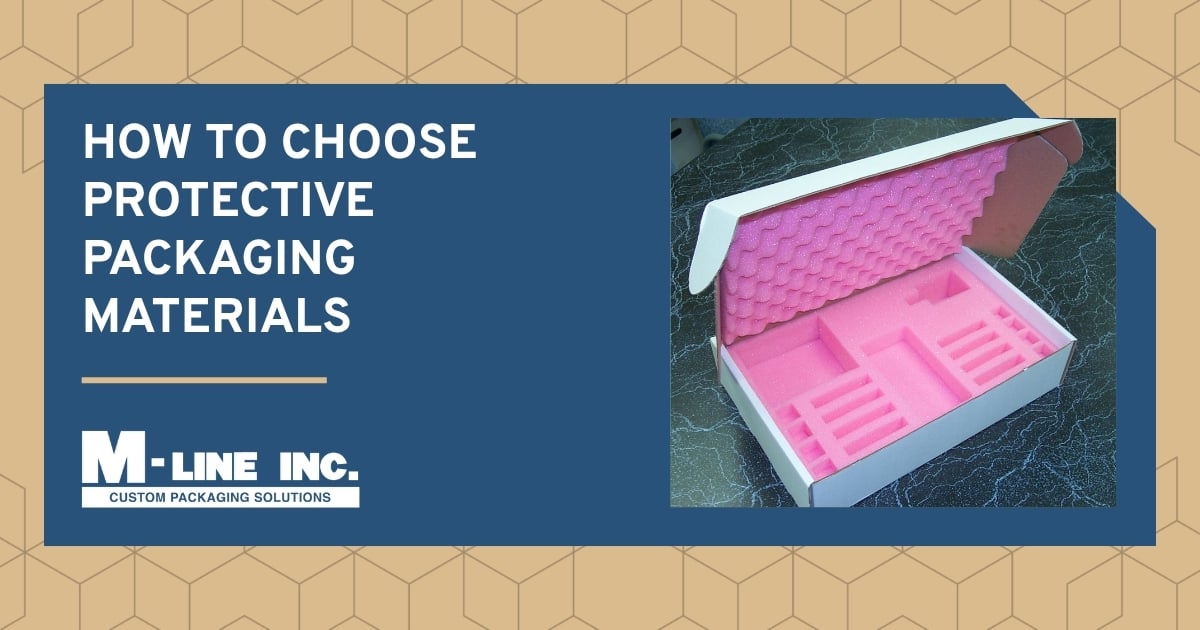
Foam is the go-to material for fragile, high-value, or irregularly shaped products. Unlike rigid materials, foam compresses and recovers, absorbing shock and vibration throughout the shipping cycle rather than transferring it to the product. Common foam types include polyethylene (PE) foam for general cushioning, polyurethane (PU) foam for light-to-medium fragility items, and cross-linked PE foam for applications requiring moisture resistance or a cleaner surface contact.
Corrugated Inserts and Partitions
Corrugated materials are cost-effective and widely used for organization, product separation, and light-to-moderate protection. They work well for heavier products with sturdy exteriors that don't require shock absorption, keeping items in place and preventing surface-to-surface contact during transit. However, corrugated has limits: it can weaken with moisture exposure, and repeated impacts will eventually compromise its structural integrity.
Combination Systems
Many applications call for both foam and corrugated materials working together. A corrugated outer structure provides rigidity and stacking strength, while foam inserts cradle the product and absorb impact. Combination systems are often the most cost-efficient approach for products that need reliable protection without over-engineering the package.
The right material choice depends on the specific product, such as being heavier, more fragile, or higher value. These items generally require foam-based protection, while the final decision also accounts for packaging assembly time, labor cost, and operational efficiency.
Why Packaging Engineering Matters
One of the most important factors in foam selection is understanding the product's weight and fragility. Packaging engineers use a cushion curve to determine how much foam is required to properly protect an item. A cushion curve helps match product weight, product fragility, foam density, performance characteristics, and the amount of foam surface area supporting the product.
The goal is to provide enough cushioning to absorb impacts without over-engineering the package. While cushion curves provide scientific guidance, experience remains essential. Some products appear durable but contain delicate internal components that are highly susceptible to damage in transit.
At M-Line, our engineering team combines testing data, industry standards, and decades of experience to develop custom protective packaging that balances protection and cost efficiency.
Common Protective Packaging Failures and What Causes Them
Many packaging failures occur because the package wasn't custom-designed for the actual shipping environment. Frequent issues include:
- Products shifting inside the package due to poor fit
- Insufficient cushioning for product weight
- Corrugated materials weakening from moisture exposure
- Damage caused by vibration and repeated handling
- Over-engineered packaging that increases shipping and storage costs
Environmental conditions can also create challenges. Humidity, temperature fluctuations, UV exposure, and long-term storage all affect packaging performance. In some cases, corrosion inhibitors or other special materials may be needed to guard sensitive products.
Testing Protective Packaging Before Production
Before any packaging design moves into full production, testing verifies that it performs as intended under real-world conditions. Depending on the product and customer requirements, testing may include:
- ISTA 2A testing — simulates the hazards a packaged product faces during distribution, including drop, vibration, and compression
- ISTA 3A testing — a more rigorous protocol covering the full distribution environment for individual packaged products
- Controlled drop testing — evaluates how a package performs when dropped from specified heights at various orientations
- Real-world shipment trials — shipping prototype packages across actual distribution routes to expose failure modes that lab testing alone may not reveal
Many manufacturers choose to ship prototype packages across the country and back before committing to production. This practical approach often surfaces important findings such as a corner crush failure, a foam bottoming-out condition, or a loose-fit issue that would otherwise only be discovered after damage claims began.
When Reusable Packaging Makes Sense
In closed-loop supply chains, returnable packaging can deliver significant, sustained savings. Although reusable containers often cost more initially, they may deliver substantial value when used repeatedly.
When a package can be used multiple times and reliably returned, the total cost per shipment is often lower than that of expendable alternatives.
The Right Protective Packaging Solution for Your Product
Protective packaging isn’t simply about material choice—it’s about understanding the product, shipping environment, and supply chain. At M-Line, we help customers prevent damage while reducing material, labor, and transportation costs.
Contact M-Line to create a custom packaging solution that improves performance and prevents shipping damage.