
M-Line Blog
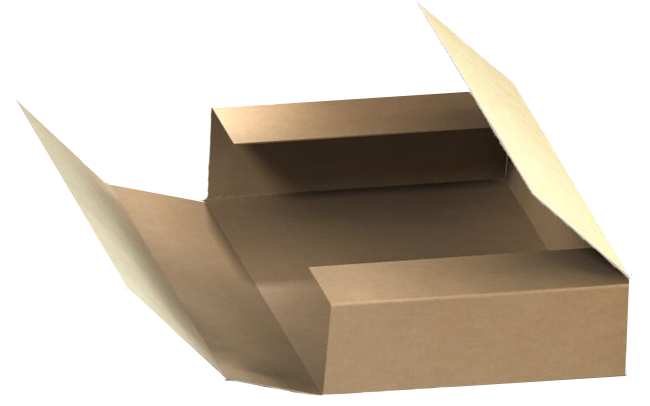

Corrugated cardboard boxes play a big role in protecting products during shipping and storage—but performance varies by design. Selecting the right construction helps prevent failures, optimize material use, and control costs throughout the supply chain. At M-Line, we engineer corrugated packaging to meet specific load, stacking, and environmental requirements—whether for retail goods or demanding industrial applications.
How Are Corrugated Boxes Made?
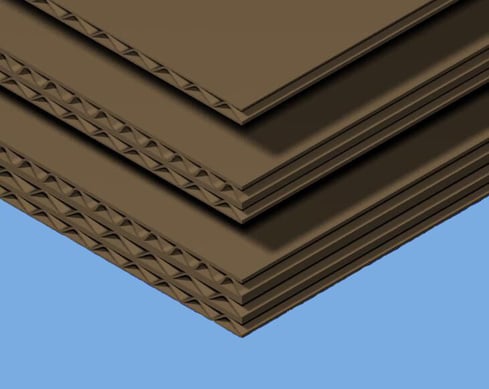
Types of Corrugated Boxes and Board Grades
Corrugated board is available in several construction types, each offering a specific combination of strength, protection, and weight capacity. Choosing the right type starts with understanding how each is built and what it is designed to handle. Use this table as a quick reference when comparing corrugated board options for your application:
| Board Type | Construction | Weight Capacity | Strength | Best For | Relative Cost |
|---|---|---|---|---|---|
| Single Face | 1 liner +1 fluted layer | Not rated (not a box) | Low | Wrapping, cushioning, void fill inside crates | Lowest |
| Single Wall | 2 liners +1 fluted layer | Up to ~60 lbs | Medium | Consumer goods, food & beverage, light industrial parts | Low |
| Double Wall | 3 liners +2 fluted layers | Up to ~120 lbs | High | Appliances, automotive parts, palletized bulk goods | Medium |
| Triple Wall | 4 liners +3 fluted layers | Up to ~150 lbs | Very High | Machinery, industrial equipment, export shipments, alternative to wood crates | High |
Single Face Corrugated
Single-face corrugated has one liner sheet and one fluted medium. With only one flat side, it is not used as a standalone corrugated box. Instead, single-face corrugated is an effective protective material for wrapping, cushioning, and separating products inside outer packaging.
Common applications include:
-
Wrapping furniture, machinery parts, or fragile components
-
Layering between stacked items to prevent surface damage
-
Edge and corner protection inside corrugated shipping containers
-
Interior cushioning inside crates or cartons
Single-Wall Corrugated Board
Single-wall corrugated is the most widely used construction for corrugated boxes. It consists of two liner sheets with one fluted layer and is suitable for products up to approximately 60 pounds, depending on box size and handling conditions.
M-Line commonly specifies single-wall corrugated boxes for:
-
Consumer goods and retail packaging
-
Food and beverage distribution
-
Small appliances and electronics
-
Light industrial components where cost and protection must stay balanced
Double-Wall Corrugated Board
Double-wall corrugated includes three liner sheets and two fluted layers, providing increased rigidity and crush resistance over single-wall construction. It is well-suited for heavier products up to 120 pounds, and for shipments that will be stacked or palletized during transit.
We frequently recommend double-wall corrugated boxes for:
-
Large appliances and electronics
-
Automotive parts and assemblies
-
Bulk packaged goods on pallets
-
Fragile items requiring additional crush resistance during shipping
Triple-Wall Corrugated Board
Triple-wall corrugated is built for maximum strength, with three fluted layers and four liner sheets. It can support up to 150 pounds and is commonly used as a cost-effective alternative to wood crates for heavy or high-value industrial shipments.
M-Line specifies triple-wall corrugated boxes for:
-
Machinery components and industrial equipment
-
Export shipments requiring exceptional durability
-
Applications where wood crates have traditionally been used
Factors to Consider When Choosing a Corrugated Box
Choosing the right corrugated box involves more than matching a weight rating to a product. The following factors all affect how a corrugated box performs in real-world shipping and storage conditions:
-
Product weight and fragility — Match board grade to the actual load and any fragility risks. A heavier product or one prone to surface damage will require a higher-grade board than weight alone might suggest.
-
Box dimensions — Larger boxes under the same weight load place greater stress on the board. A product weighing 40 lbs in a large box may require double-wall construction where the same product in a smaller box would be fine in single-wall.
-
Edge Crush Test (ECT) rating — The ECT rating measures how much top-to-bottom pressure a corrugated box can withstand before the edges buckle. Higher ECT ratings are required for stacked or palletized shipments.
-
Shipping and handling frequency — Products that move through multiple distribution points or are handled repeatedly need a more robust corrugated construction than direct-to-customer shipments.
-
Stacking and palletizing requirements — If boxes will be stacked on pallets during storage or transit, compression strength becomes a primary selection factor. This is typically where single-wall reaches its limits.
-
Environmental exposure — Moisture, humidity, and temperature extremes all degrade corrugated board performance. Products shipped in refrigerated environments or exposed to outdoor conditions may require moisture-resistant treatments or upgraded board grades.
If you are already using a corrugated box for your product, the certification stamp printed on the bottom is a useful reference. It identifies the box manufacturer, board grade, and whether the construction is single, double, or triple-wall.
Need Help Choosing the Right Box?
Understanding corrugated board grades is a great starting point but working with an experienced packaging engineer ensures the best outcome. M-Line’s all-in-one product packaging experts turn your concepts into production ready solutions.
If you’re unsure which board grade, box style, or protective configuration is best, contact M-Line today.